Not long ago, success in commercial real estate was measured largely by location, leasable area, and rental yield projections. While these fundamentals still matter, they are no longer sufficient on their own. Today, experienced investors evaluating projects across Chandigarh, Mohali, and Zirakpur are asking a deeper question: Will this asset remain relevant as the way people work, operate businesses, and use space continues to evolve?
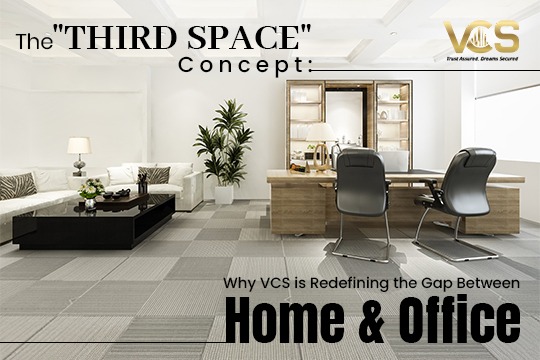
This shift in thinking has brought attention to what is increasingly known as the Third Space — a category of commercial environments that sit between home and the traditional office. These spaces offer structure without rigidity and flexibility without compromise, addressing the changing expectations of modern professionals and businesses.
Understanding the Third Space from an Investor’s Perspective
The Third Space is not a passing workplace trend. It is a structural response to long-term changes in professional behaviour across the Tricity region. Hybrid work models, independent professionals, startups, consultants, and service-oriented businesses have all reshaped demand patterns in commercial real estate.
From an investor’s point of view, the Third Space represents a clear shift away from single-use, single-tenant dependency. Instead, it favours multi-use environments that are experience-driven and capable of serving diverse occupier profiles. This approach is increasingly visible in well-planned commercial developments that recognise how workspaces are actually being used today.
Such adaptability is critical. Assets designed with flexibility at their core are better positioned to navigate economic cycles, changing tenant expectations, and evolving business models without losing relevance.
Why Conventional Commercial Projects Are Losing Relevance
Traditional commercial developments were built for a predictable world — one where businesses expanded steadily, teams worked from central offices five days a week, and long-term leases were the norm. That predictability has steadily eroded.
Today, businesses prefer smaller but more efficient spaces, professional environments that support productivity, and locations that reduce daily friction. The growing preference for Grade A office environments in Mohali reflects this shift. As a result, purely office-focused or purely retail-focused projects are under pressure to justify their relevance.
This is why investors are increasingly moving away from outdated formats and paying closer attention to new commercial developments that can adapt over time, particularly high-rise and mixed-use projects emerging in Zirakpur and along key growth corridors.
VCS Brahma: A Physical Expression of the Third Space
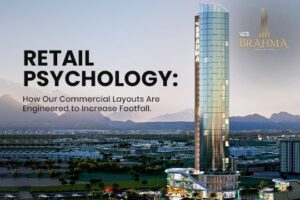
VCS Brahma has been conceived with this evolving reality in mind. Developed by VCS Builders and Developers, the project is positioned as a large mixed-use commercial high-rise on Mohali Airport Road (PR-7), a corridor that continues to attract sustained business and investor interest.
Rather than functioning as a single-purpose commercial asset, the development integrates retail spaces, showrooms, studios, and service suites within one vertical ecosystem. This configuration allows it to serve a wide range of users — from businesses seeking a visible commercial presence to professionals looking for well-located, flexible work environments.
This ability to support multiple use cases strengthens its long-term relevance and positions it as a strong commercial option within the Zirakpur market.
Location as a Strategic Investment Advantage
In commercial real estate, location is not only about address; it is about access, visibility, and durability of demand. Mohali Airport Road (PR-7) has emerged as a strategic spine connecting Chandigarh, Mohali, and Zirakpur, making it an attractive zone for commercial activity.
The corridor benefits from proximity to residential catchments, airport connectivity, and strong regional movement. For investors, this translates into consistent footfall and sustained commercial interest, particularly for retail formats and business-oriented spaces. Assets located here tend to benefit from broader regional relevance rather than reliance on a single micro-market.
Scale, Height, and Landmark Value
Promoted as the tallest commercial tower in Punjab, rising approximately 32 floors, VCS Brahma carries clear landmark value. In a region like Tricity, scale and height contribute to visibility, brand recall, and long-term perception.
Landmark commercial developments often attract stronger tenant interest and enjoy better positioning over time. From an investment standpoint, this scale reflects a project designed for long-term prominence rather than short-term speculation.
Mixed-Use Planning and Demand Diversification
One of the strongest fundamentals of VCS Brahma lies in its mixed-use planning, which allows demand to emerge from multiple segments.
- Retail and showroom spaces designed for visibility-driven businesses
- Studios and service suites catering to professionals and entrepreneurs
- Flexible commercial layouts suitable for evolving operational needs
This diversified structure helps reduce vacancy risk and supports more stable occupancy patterns over time.
Designing for Human Behaviour, Not Just Floor Plans
Modern commercial performance is increasingly influenced by how people experience a space. Factors such as natural light, circulation, zoning, and ease of movement play a direct role in productivity and user satisfaction.
Well-designed commercial projects today focus on human-centric planning rather than purely visual appeal. VCS Brahma reflects this approach by creating environments that support sustained work, ease of movement, and professional comfort. Over time, this directly contributes to tenant retention and asset longevity.
Amenities as Value Drivers, Not Add-Ons
In Third Space–oriented developments, amenities are no longer optional extras. They play an active role in extending the daily usability of the asset.
- Business lounges and cafeterias support informal interactions
- Fitness and wellness facilities that complement work routines
- Robust security systems and reliable power infrastructure
- Adequate parking designed to support commercial footfall
These elements enhance overall asset quality and strengthen investor confidence.
Future-Readiness and Risk Mitigation
From an investor’s standpoint, one of the biggest risks in commercial real estate today is obsolescence. Assets that fail to adapt often struggle, even when located in otherwise strong markets.
The Third Space model mitigates this risk by supporting multiple occupier profiles and evolving work styles. Projects aligned with this approach are better equipped to remain relevant as business needs continue to change.
Conclusion
The future of commercial real estate will be shaped by environments that understand people, productivity, and changing business realities. The Third Space represents this future — and VCS Brahma reflects it in built form.
As a landmark high-rise commercial development in Mohali, it offers investors a combination of scale, adaptability, and long-term relevance. In a market where relevance increasingly defines returns, projects designed around how work is evolving are better positioned to deliver sustained value.