Three years ago, the PR-7 stretch of Airport Road in Zirakpur was open plots and a handful of low-rise showrooms. Today, it’s cranes, glass, and steel racing skyward, and it’s become the clearest physical proof that Tricity is no longer just a residential market. Somewhere between Mohali’s IT corridors and Chandigarh’s overflowing office space, this corridor quietly turned into the region’s next commercial frontier, and one name keeps surfacing every time people talk about who’s leading that shift: VCS Builders.
It’s a fair question to ask why. Airport Road alone has commercial signboards up on nearly every plot, all promising some version of the same thing. Most of them blur together, with the same language, glossy renders, and vague talk of “world-class living.” So, what makes VCS different enough that people are pointing to it as proof of where this region is headed, rather than just another name competing for the same billboard space?
A Builder That Didn’t Just Chase Trends
Most developers in Tricity built their reputation on residential projects, flats, plots, and the occasional gated community. VCS Promoters and Developers started there too, with projects like The Vasudha, catering to homebuyers in Mohali and Kharar. But somewhere along the way, the company made a call that many builders in this region hadn’t: it decided that commercial real estate wasn’t a side business, but the next big opportunity.
That’s not a small pivot. Residential real estate and commercial real estate run on completely different playbooks, including different buyer psychology, compliance requirements, and design priorities. A homebuyer wants comfort and emotional connection. An investor or business owner wants footfall, connectivity, and return on capital. Getting good at one doesn’t automatically make you good at the other. VCS made that jump deliberately, and it shows in how their commercial projects are positioned, not as an afterthought bolted onto a housing portfolio, but as a genuine specialization.
Design That Doesn’t Play It Safe
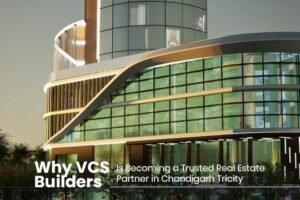
If you look at what VCS has built and what it’s building now, there’s a pattern: none of it looks like it’s trying to blend in. The design language leans toward vertical development over sprawling low-rise layouts, a deliberate choice given how limited and expensive plotted land has become along Airport Road. Building up rather than out lets a project pack more Grade-A leasable space onto a smaller footprint, while freeing up ground-level area for plazas, drop-off zones, and green buffers instead of losing it all to construction coverage.
That’s a standard strategy in dense metro commercial corridors like Gurugram’s Golf Course Road or Delhi’s Aerocity, and it’s still uncommon enough in Tricity that it makes VCS’s projects stand out on the skyline rather than blend into it. There’s also a sustainability thread running through their work that doesn’t get talked about enough, with green cover and open-plaza space worked into the layout instead of treating landscaping as an afterthought once construction wraps up.
In a market where “eco-friendly” is often just a line on a brochure, actually reserving ground-floor and terrace space for it is a small but telling difference.
Trust Isn’t Claimed, It’s Accumulated
Anyone can put “trusted” or “leading” in their tagline. What actually builds trust in real estate is boring, unglamorous stuff: delivering on timelines, being transparent about pricing, and having leadership that’s been in the local market long enough to have a reputation to protect.
VCS is registered as VCS Promoters and Developers LLP, headquartered at SCO No. 1013, Connaught Plaza, TDI City, Balongi, Mohali, not a virtual office or a marketing address, but the same corridor the company is actively building on. That kind of proximity between where a developer works and where it builds isn’t cosmetic. It means site visits, vendor checks, and construction oversight happen without layers of distance in between. The leadership isn’t anonymous either. Suniljeet Singh, Chairman of the VCS Group, built his background as an investor across multiple Tricity real estate ventures before launching VCS’s own projects.
That combination, an investor’s read on where a market is heading, paired with hands-on leadership of execution, is a big part of why VCS’s move into commercial development reads as a calculated bet rather than a guess. That’s the quieter reason VCS keeps coming up in conversations about who’s “redefining” the builder landscape here. It’s not one flashy project. It’s a track record of residential delivery that earned enough goodwill to be trusted with something far bigger.
There’s a pattern worth noticing in how real estate credibility actually gets built in a market like Tricity. It rarely comes from advertising spend. It comes from word of mouth among people who’ve already bought, a homeowner telling a colleague the possession date was actually honored, or a shopkeeper mentioning that the paperwork was clean and didn’t drag on for months.
The Brahma: Where the Ambition Becomes Visible
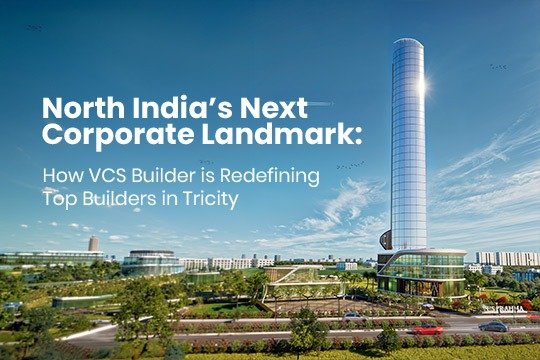
Sitting on Mohali Airport Road in Zirakpur, The Brahma isn’t a modest commercial block. It’s a 34-storey tower, currently positioned as Punjab’s tallest commercial development. That’s not just a marketing number. Height at this scale changes what a building can offer: panoramic views that become a selling point for premium offices, a rooftop terrace that functions as a genuine amenity rather than a token feature, and a sense of scale that signals long-term ambition rather than a quick, cash-and-exit project. Location is doing a lot of the work here, too. The tower sits directly on the PR-7 Airport Road stretch in Zirakpur, the same corridor now anchoring Aerocity-adjacent commercial clusters, putting it within easy reach of Chandigarh, Mohali, and the wider Tricity road network.
It is also just minutes from Mohali International Airport and the IT corridors driving a lot of the region’s new commercial demand. For a business, that combination of visibility and connectivity is close to the whole pitch: high footfall, easy access for clients and employees, and an address that reads as “this company has arrived,” not “this company is still figuring things out.”
The project itself is built around a variety rather than a single use case. There’s high-street retail for brands that want visibility. There are office suites for companies that want a serious corporate address. There are business studios and serviced spaces for smaller teams or startups that aren’t ready for a full floor but still want a premium location. That mix matters for investors specifically. A building with diverse tenant types can potentially be more resilient than one betting everything on a single sector. On the amenities side, VCS has clearly thought about what a modern workday actually looks like, not just what looks good in a floor plan.
A clubhouse for informal meetings and events. Smart, efficient parking, which anyone who has driven through a Tricity commercial hub during peak hours knows is not a small thing. A fitness center, a professional lounge, and a lobby designed to make the right first impression for clients walking in.
For investors, the pitch has been fairly direct: strong rental yield potential, capital appreciation tied to Zirakpur’s growth trajectory, and entry into a commercial project with brand weight behind it rather than an unknown developer testing the market.
VCS The Brahma: Quick Facts
| Feature | Details |
| Location | Mohali Airport Road, Zirakpur |
| Height | 34 storeys |
| Project Type | Mixed-use commercial |
| Space Options | High-street retail, office suites, business studios, serviced spaces |
| Connectivity | Close to Chandigarh, Mohali, Mohali International Airport, and key IT corridors |
| Key Amenities | Clubhouse, smart parking, fitness center, professional lounge, rooftop terrace, grand lobby |
| Investment Appeal | Rental yield potential, capital appreciation, diversified tenant mix |
What This Really Signals
Step back from the individual project, and the bigger story is about Tricity itself. Regions don’t become corporate hubs because of infrastructure alone — they need developers willing to build for that future before the demand is fully proven. That’s a real bet, and it’s the kind of bet that either looks visionary in five years or looks premature. Right now, with IT parks expanding around Mohali and Chandigarh’s commercial space getting tighter, the timing looks like the former.
VCS Builders isn’t the only developer working in this space, and it shouldn’t be treated as the last word on Tricity’s commercial future. Other players will enter, some already have, and competition is generally good for buyers and investors alike. But it is one of the clearest examples of a local builder scaling up its ambition in step with the region — moving from homes to landmarks, and backing that move with an actual project you can walk into rather than just a promise on a brochure.
What tends to separate developers who last from those who don’t is whether the ambition is matched by follow-through. A tall building is easy to render. A tall building that gets delivered on schedule, fills up with genuine businesses, and holds its value five years later is a different achievement entirely. That’s really the test VCS has set for itself with The Brahma — not just to build Punjab’s tallest commercial tower, but to prove that a homegrown Tricity developer can execute at that scale without losing the reliability that built its name in the first place.
If Tricity is genuinely becoming North India’s next corporate address, projects like The Brahma are less a prediction of that future and more an early, physical proof of it. For anyone tracking where this region is headed — as a homebuyer, a business owner scouting office space, or an investor looking for the next market before it peaks — VCS Builders is a name worth watching closely over the next few years, not just for what it’s already built, but for what it signals about where Tricity itself is going.
Frequently Asked Questions
1. What makes VCS Builders different from other developers in Tricity?
VCS built its reputation first in residential real estate, then made a deliberate, well-planned move into commercial development rather than treating it as an afterthought. That grounding in local trust, combined with bold architectural choices, sets it apart from newer or purely opportunistic developers in the region.
2. What is VCS The Brahma known for?
The Brahma is a 34-storey commercial tower on Mohali Airport Road in Zirakpur, currently positioned as Punjab’s tallest commercial development. It’s known for its scale, prime connectivity, and mix of retail, office, and business studio spaces.
3. Is VCS The Brahma a good option for investment?
It’s being positioned around strong rental yield potential and long-term capital appreciation, backed by a developer with an existing residential track record. As with any commercial investment, it’s worth evaluating current pricing, possession timelines, and lease demand independently before committing.
4. Where exactly is VCS The Brahma located?
It’s situated on Mohali Airport Road in Zirakpur, offering close connectivity to Chandigarh, Mohali, the airport, and the region’s expanding IT hubs.
5. What kind of spaces can you buy or lease at VCS The Brahma?
The project offers high-street retail spaces, premium office suites, and smaller business studios or serviced spaces, catering to everyone from large companies to startups and independent retailers.
Conclusion
Tricity’s shift from a residential-first market to a genuine corporate destination isn’t happening by accident, and VCS Builders is one of the clearest examples of a local developer building for that future deliberately. Its move from trusted residential projects into ambitious commercial developments like The Brahma reflects both confidence and preparation, not a random bet made to chase a trend. For homebuyers, business owners, and investors alike, VCS represents a rare combination in this market: local credibility earned over years, paired with metro-level design ambition rarely seen outside cities like Delhi or Gurugram.
As Mohali, Zirakpur, and Chandigarh continue attracting IT parks, growing corporates, and premium retail brands, the developers who invested early in commercial infrastructure stand to benefit the most from that momentum. VCS Builders, backed by The Brahma’s scale, location, and thoughtful design, is positioning itself right at the center of that shift — a name worth watching closely as Tricity’s corporate landscape continues to take shape over the next few years.