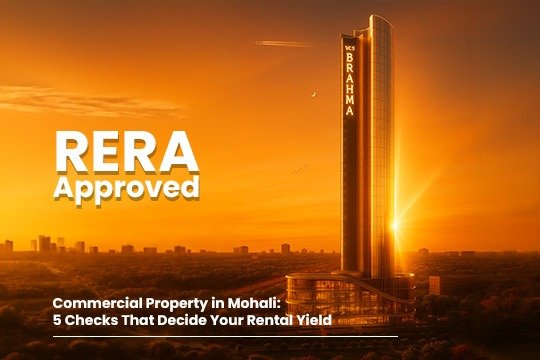
RERA registration tells you a commercial project is legal. It does not tell you whether it will earn. For commercial property in Mohali, rental yield depends on five things RERA never audits: road access and catchment, lift capacity, parking design, tenant mix, and usable floor area. Check all five before you pay a booking amount.
A RERA number confirms three things: the project is registered, buyer money is ring-fenced in a designated account, and timelines are disclosed on record. That is legal safety. Yield is a different audit, and most buyers skip it.
This guide gives you that second audit. We test each check against VCS The Brahma, a 34-storey commercial tower on PR-7 Airport Road, Zirakpur, positioned as the tallest commercial tower in Punjab.
Why Isn’t RERA Registration Enough for Commercial Investors?
RERA protects you from legal and delivery risk. It does not forecast rent, footfall, or tenant retention. Among RERA-approved commercial projects in Mohali, registration is now the minimum entry ticket, so it cannot separate a strong investment from a weak one. Design and location do that.
Think of it as two audits:
- Legal audit (RERA): Is the land clean, is the plan sanctioned, is the money protected?
- Commercial audit (you): Will tenants come, pay a sensible rent, and renew?
A building can pass the first and fail the second. The five checks below are the second audit.
Check 1: Is the Location on a High-Traffic Corridor?
Footfall follows road access, not sector numbers. A showroom on a wide arterial road gets passing traffic that converts into walk-ins with no marketing spend. A unit in a quiet sector depends on customers choosing to travel there.
PR-7 Airport Road is an arterial corridor linking Chandigarh, Mohali, and Zirakpur, and it carries traffic from Punjab, Haryana, and Himachal Pradesh toward the airport. That gives commercial space on PR-7 a tri-state catchment, not a single-city one.
When you compare commercial property near Chandigarh Airport or office space near Aerocity Mohali, measure these:
- Daily vehicle count on the frontage road
- Public transport access to the site
- Travel time from the airport, big residential belts, and the highway
- Whether the road width allows safe entry and exit
Why it matters for returns: higher footfall speeds up tenant ramp-up and gives you stronger rent negotiation.
Check 2: Does the Tower Have Enough Lifts?
Lift planning decides whether upper-floor offices stay rentable. In a tower above 30 floors, too few or badly zoned lifts mean long morning and evening queues. Tenants on those floors leave at renewal, and you are forced to discount the rent.
| Question | What a good answer looks like |
| Passenger lifts per leasable floor area | A stated ratio, not a vague “high-speed lifts” claim |
| Lift zoning | Separate low-rise, mid-rise, and high-rise banks to cut stops per trip |
| Service and fire lifts | Dedicated, so goods never compete with visitors |
| Lobby sizing | Built for peak load, not average load |
Why it matters for returns: every avoided vacancy month protects your yield, and tenants who move staff and clients easily tend to renew.
Check 3: Is Parking Built for Customers?
Retail fails at the parking gate before it fails at the shelf. If a shopper circles for ten minutes or meets a jammed ramp, the visit never happens. The tenant’s sales drop, and showroom rent is only sustainable if sales support it.
For showroom and office buyers on Airport Road, check:
- Basement capacity relative to total built-up area
- Separate entry and exit ramps, so peak hours don’t queue onto the main road
- Wide pedestrian aprons that give showrooms visible frontage
- Drop-off points for cab and delivery vehicles
Projects that plan parking as revenue infrastructure, not a compliance box, hold footfall through weekends and sale seasons.
Check 4: Does the Building Have a Mixed-Use Tenant Mix?
A mixed-use tower spreads demand risk. A single-use building depends on one demand cycle. When retail, F&B, offices, and amenities share one address, each feeds the others: office staff becomes lunch customers, and retail visitors become leads for the offices above.
For an investor, tenant mix works as a vacancy hedge:
- Retail and F&B drive visibility and evening traffic
- Offices bring weekday volume and longer lease terms
- Service suites and business studios attract short-stay professionals and travelling executives, which suits a site near the airport
The result is footfall seven days a week instead of a Monday-to-Friday spike. When you evaluate the best commercial property in Zirakpur, don’t ask how many units are sold. Ask how many different demand sources the building can sustain.
Check 5: How Much of the Area Is Actually Usable?
Two units sold as 1,000 sq ft can give very different rentable space. The gap is loading: the difference between carpet area and super area. You pay for corridors, lobbies, and structure, but your tenant only uses the carpet.
Rent follows what a tenant can use. So check:
- Carpet-to-super-area ratio stated in the RERA filing
- Floor-plate shape and column placement. Irregular layouts waste space.
- Core design. Compact lifts, stairs, and ducts leave more usable area.
An efficient floor plan lets a tenant fit more workstations or display racks per square foot. That lifts the rent a unit can command and shortens gaps between leases.
RERA Check vs. Yield Check: Quick Comparison
| Parameter | What RERA Verifies | What Drives Yield |
| Location | Land title and approvals | Road width, traffic volume, catchment reach |
| Structure | Sanctioned plan compliance | Lift zoning, peak-hour vertical capacity |
| Parking | Minimum norm compliance | Ramp design, customer ease, frontage access |
| Use mix | Declared project type | Tenant diversity, 7-day footfall |
| Area | Carpet area disclosure | Usable space ratio, layout efficiency |
| Timeline | Declared possession date | Developer delivery record, leasing readiness |
| Outcome | Legal protection | Rental yield and appreciation |
How Do You Judge the Developer?
Delivery history separates reliable developers from risky ones. When you assess VCS Builders’ commercial developments, or any developer in Mohali, look at three things: projects already delivered, occupancy in those buildings today, and how the developer handles post-sale management. A well-managed building keeps tenants and holds its value.
FAQs
What does RERA registration actually guarantee for a commercial buyer?
It guarantees that the project is registered with the regulator, that its approvals and timelines are disclosed, and that buyer funds sit in a designated account. It does not guarantee footfall, rent levels, or tenant retention. Those depend on location, design, and management.
How do I check rental yield before buying commercial property in Mohali?
Divide expected annual rent by the purchase price, then compare it with nearby buildings. Ask for current rents on similar units, check occupancy in the developer’s delivered projects, and confirm usable carpet area. A high yield on paper means little if the building sits half empty.
Why is PR-7 Airport Road considered a good commercial location?
It is an arterial corridor connecting Chandigarh, Mohali, and Zirakpur, and it carries traffic from Punjab, Haryana, and Himachal Pradesh toward the airport. That means frontage units get passing traffic from several cities, not only residents.
Is commercial property near Chandigarh Airport better than a sector location?
It depends on the business. Airport-side corridors suit showrooms, F&B, and service suites that benefit from passing and travelling customers. Sector locations can suit destination businesses and carry lower prices, but they rely on customers choosing to come.
What is the difference between carpet area and super area?
Carpet area is the space a tenant can actually use inside the unit. Super area adds a share of common areas such as lobbies, corridors, and structure. The bigger the gap, the more you pay for space your tenant never uses.
How many lifts should a 30+ floor commercial tower have?
There is no single legal number that guarantees good performance, so ask the developer for the lift-to-leasable-area ratio and the zoning plan. A good tower separates low-rise, mid-rise, and high-rise lifts and keeps dedicated service and fire lifts.
What should I ask a commercial developer before booking?
Ask for the RERA registration number, floor plans with carpet ratios, the lift and parking plan, the tenant-mix strategy, and a list of delivered projects with their current occupancy. Then visit the site at peak hours to see traffic and assess yourself.
Conclusion
RERA registration is the baseline, not the finish line. Returns come from how well the building is designed to attract tenants and keep them: connectivity, lifts, parking, tenant mix, and space efficiency.